Category Archives: Aviation history

Flying Blind publication

FlyingBlindCoverFrontThe book of my father’s memoirs, ‘Flying Blind: the Story of a Night-Fighter Pilot’, is now at the press and is likely to be available from mid-October.

The book is published by Fonthill Media.

Watch this space!

Or if you would like to subscribe to my email newsletter ‘Flying Blind’ to keep up to date with developments on the book, its publication and feedback afterwards, just complete the following form. I only send newsletters from time to time when there is something to impart, and you can unsubscribe easily at any time using the link at the bottom of each edition.

Go back

Your message has been sent

Warning
Warning
Warning
Warning

Warning.

Leave a comment

Filed under Aviation, Aviation history, books, Second World War

£200.00 in donations

I have now collected a total of just over £200.00 through the Where They Served project, some of which has gone to the RAF Charitable Trust as part of the Pre-War Prescott ticket donations, but the majority of course is for the RAF Benevolent Fund. My thanks to all those who have donated so generously so far.

It may seem as if things have gone quiet at the moment, but in fact it is all very busy behind the scenes. The airfields tour proper is scheduled to start in April 2015, and currently Ground Control and I are working on the itinerary, which is quite a big job.  On the vehicle side, Thetford Engineering have booked Chattie into their vintage car workshop for a complete assessment and overhaul, which will happen, hopefully, at the end of September, and work on the car will I suspect be continuing throughout the Autumn months, as we also have to try and fit her with an all-weather hood.  I am also working on raising sponsorship for next year.  If you can help with this, or are interested in sponsoring Where They Served for the national tour next year, please get in touch.

2 Comments

Filed under Aviation, Aviation history, Second World War, Singer Le Mans, Uncategorized, vintage cars

Mercedes-Benz

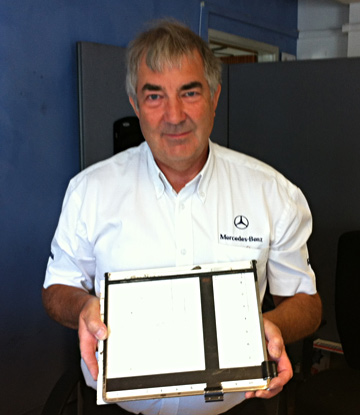
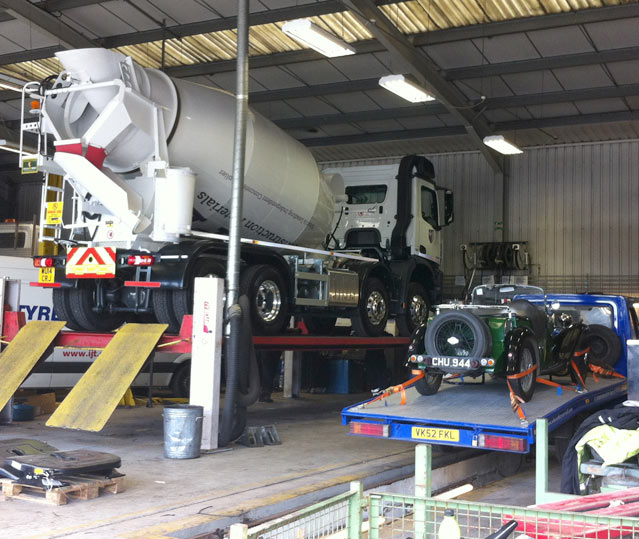
Ground Control and I are going back to Kidderminster tomorrow to pick up the Sprinter (still loaded up with Chattie) after its service. A rather expensive service, as it turns out, but at least we know the Sprinter is good and roadworthy. We had to take it to the Mercedes-Benz dealer, and as I chatted to their Service Advisor, Andrew Brown, he said, ‘My father was in the RAF, too’.  Turns out his father, Thomas Royster ‘Roy’ Brown, was a Ground Crew engineer with one of the reconnaissance squadrons.  ‘In fact,’ said Andrew, ‘It’s funny you should come today, because I’ve got this with me; it’s from a Spitfire’ and he reached down beside the desk and picked up a piece of equipment that looked like something you might use for technical drawing. See photo:

AndreBrownRygo

Andrew Brown, with equipment from his father’s Spitfire reconnaissance squadron, used to translate the photographic information into accurate compass bearings and miles to target.

Andrew explained that his father worked on the photographs brought back by the reconnaissance Spitfires, taking the plates off the aircraft and analysing them, in order to work out the distances and degrees on the photographs and translate them into miles and readable navigation routes. These would then be fed back to the bomber squadrons, pinpointing the target and how they were going to reach it: a vital part of the ability of Bomber Command to get its planes to target successfully. This piece of equipment Andrew is holding, calibrated for this purpose, was used in this way by his father.

Meanwhile, Chattie is in good – if rather overwhelming – company!
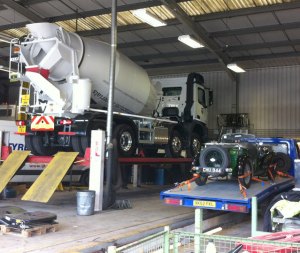
SprinterInRecovery


Leave a comment

Filed under Aviation, Aviation history, Second World War, Uncategorized

Do Tiger Moths use Tom Toms?

Having got on the wrong side of a GPS system over my Pre-War Prescott weekend, when it led me and my carrier up a very narrow, very steep road instead of the sensible way round, I wondered how one navigates when flying a pre-war plane like Paul Harvey’s Tiger Moth.  Do you use pre-war navigation techniques, and if so, what are they (looking over the side, for example, to see where you are!); and if you use modern navigation techniques, what does that involve?  Do you use a kind of ‘aviator’s Tom Tom’?  Excuse me asking this daft question, but I’m not a pilot, not an aviation ‘buff’, so the only way I can find out is to ask…

2 Comments

Filed under Aviation, Aviation history, Uncategorized

Prescott Tiger Moth disappointment

1401704F

Tiger Moth G-AFWI, known in Dad’s log book as BB814. Photo courtesy of owner Paul Harvey. She is in her pre-war livery.

Of course the big disappointment for me and my cousins was the fact that the Tiger Moth, G-AFWI/BB814, in which my father learned to fly, was not able to be flown over from Norfolk by its owner Paul Harvey because of the bad weather.  My brother Andrew, who lives in the States, was also unable to get over for Pre-War Prescott, though he would absolutely have loved to see the Tiger Moth.  Also rained off from the event were my father’s two step-brothers, Derek and Chris, and their wives, and Harry Birkner, a relative on our Grandmother’s side, all of whom were aiming to join us for today. However, we’re hoping that we can meet up with Paul and the Tiger Moth sometime next year, and if Andrew can get over at the same time, that would be fantastic. I will now work on the schedule for next year and see what we can come up with.  All heartfelt thanks to Ian Grace of Pre-War Prescott and for Paul Harvey for attempting to make this dream possible – we still hold out for next year!

Leave a comment

Filed under Aviation, Aviation history, Uncategorized, vintage cars

Royal International Air Tattoo

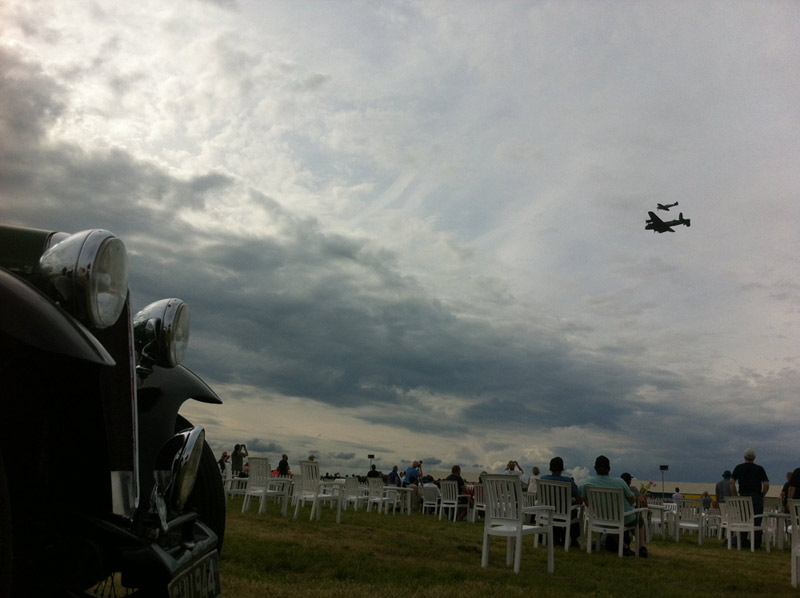
What a weekend.  Near-perfect weather and for someone who has never seen a real airshow at all, it was wonderful to start with probably the best in the world. The Red Arrows – thrill, precision and an excellent commentary from ‘Red 10’, the airbus with its ponderous bulk and fluked tail graceful in the sky like a whale in the water; the grace of the Polish formation – grey-glint and silver gleam against the cloud base; the flamboyant Italian display generous in sweep and character and a commentary that delighted with enthusiasm – ‘There he goes!  Up! up! up into the sky!’; the sheer power and bone-rattling noise of the jets conveyed not so much through the air as in immediate and direct connection through the ground and our very bones – all this was thrilling. But the highlight of highlights for me was the Battle of Britain Memorial Flight: Lancaster majestic in the air, accompanied by the iconic Spitfire and Hurricane – the note in the drone of their engines we all recognise, even though we weren’t there then. Thank you everyone who put the show on for us, and the tremendous staff and volunteers who were utterly exceptional (thanks, Christian, for your help over the weekend). See my Facebook page facebook/wheretheyserved for more pictures. Here’s just one:

Chattie watches Lancaster and Spitfire overhead

Chattie watches Lancaster and Spitfire overhead

Leave a comment

Filed under Aviation, Aviation history, car, vintage cars

Night Fighter Navigator by Dennis Gosling DFC

Again, at Shobdon, I was talking to a lady whose relative had been a radio operator during the war, and this brought to mind a great book I have read recently: “Night Fighter Navigator: Beaufighters and Mosquitos in World War II” by Dennis Gosling DFC.  I was particularly interested in his account because in many ways it mirrors that of my father, who also flew Beaufighters and Mosquitos as a night-fighter.  His long-standing navigator was Flt Sgt Ralph Gibbons, and Dennis Gosling’s book gave me a rare glimpse of the story from the navigator’s point of view.  My father’s experience of the RAF was almost universally positive and friendly; Dennis Gosling’s was not like this at the beginning of his wartime career but later he realised he had been unfortunate and his later squadrons were much more welcoming, with the social integration of rank and class more like that of my father’s remembrance.  I found it a good page-turner, even though it’s not a traditional ‘action-packed’ account of war, and would recommend it for an interesting and touching read.

Leave a comment

Filed under Aviation, Aviation history, Second World War, Uncategorized

That’s not a Spitfire, it’s a Defiant.

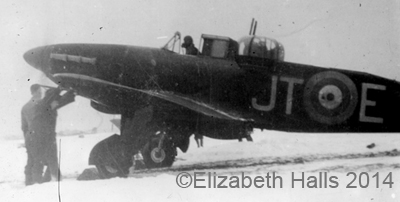
I have been asked why I pictured my father with a Spitfire when he flew Mosquitos during the war.  There are two answers to that.  The first is that Dad flew 14 different aircraft altogether (not including different marks of aircraft).  The second is that it’s not a Spitfire, it’s a Defiant.  Boulton Paul Defiants flew in the Battle of Britain, but were better designed for attacking slower bombers than interception in fighter combat.  Yes, there is a similarity of outline to the Spitfire, and this meant that they could masquerade as Hurricanes or Spitfires in a crowded sky but were marked out when German fighters found them on their own, and shot down easily. The tell-tale giveaway is the perspex blister behind the cockpit on top of the fuselage: a gun turret housing the gunner, which means that is therefore a two-man plane not a solo job like the Spit and Hurricane. Defiants suffered heavy losses in the Battle of Britain, see http://www.raf.mod.uk/history/boultonpauldefiant.cfm , but the time Dad flew them in July 1941 in 456 Squadron at RAF Valley in Anglesey, and then 256 Squadron at Squires Gate, Blackpool, they were being used as night-fighter planes, defending cities in the North West from German bombing, for which they were better suited. There were still problems with them, however, and they were not universally popular.  

Defiant

The photo shows pilot Bryan Wild and his gunner, Stanley (Ack) Greenwood, preparing for take-off in a Defiant at Squires Gate, December 1941.

Dad also flew Hurricanes and a few Spitfires in his time, as well as the aforementioned Mosquito. ©Elizabeth Halls 2014

Leave a comment

Filed under Aviation, Aviation history