It’s quite a feeling to drive up towards the flat horizon, knowing that beyond the little village of Valley is the airfield where Dad first flew as a night-fighter pilot in 1941 (456 Squadron). I wondered which of the older little terraced houses might be the one where a lady made a bit of extra cash by serving home-cured ham and fresh eggs in her front room, which Dad and his friends used to frequent. They kept it as secret as they could from the rest of the Squadron. It was quite a feeling to drive through the Station and then for Chattie to be lined up with a Hawk jet for our official photograph. 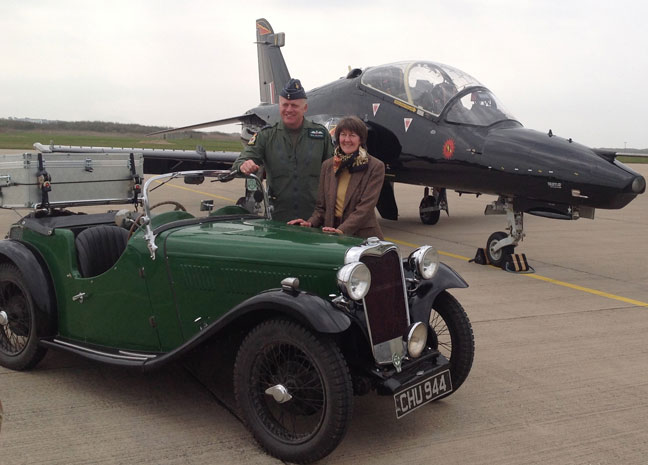 As I shook hands with Station Commander Group Captain Peter Cracroft I couldn’t help picturing my Dad’s amazed reaction if he could have known that this would be happening. He was always proud of serving at Valley. The Station Commander told me that the highest risk at the Station was still that of vehicles straying onto the runway. Seventy-four years after Dad hit that stray cook-wagon while trying to land at 110 miles an hour, it seems that potential hazard has not changed!
 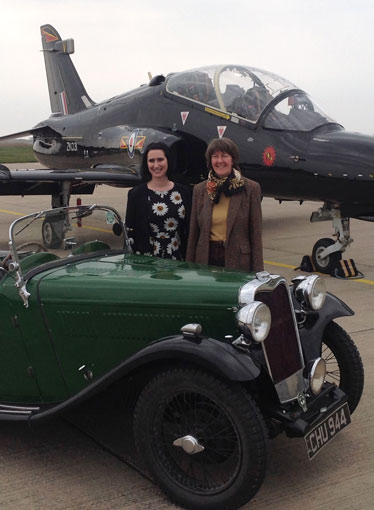 The lovely Cerys, who supports my efforts from the RAF Benevolent Fund, had flown up from Cardiff in the morning; my thanks go to her, and to Darren at RAF Valley who escorted and guided us throughout our stay. After leaving the Station, and I said goodbye to them both at the ‘spotters’ car park’ nearby, a jet thundered by right over our heads. ‘I would like to say I had arranged that for you!’ said Darren. From that car park, I sat a little while looking over the airfield. From here, in a way, it is easier to get a feel for it as it was in 1941. Just the grass between the runways, and a few older hangars and airforce buildings over to the right. In front of me, Darren had pointed out a red light in the grass, where the perimeter track turns in towards the live runways. ‘That is the same system your Dad would have known – that is what the cook wagon ignored when your father was landing his Defiant.’ A strange feeling to finish with, contemplating that red light nestling in the grass, and thinking how close a shave it was that day for my Dad when he crash-landed on the one remaining oleo leg and finished up in the dunes beyond my line of sight. If he had been only 11 feet off the ground when he hit the cook wagon, instead of 12 feet, he would probably not have survived. Then I wouldn’t have been here to visit RAF Valley in a 1935 Singer Le Mans, that’s for sure.
Category Archives: Second World War
RAF Valley and the start of my Where They Served tour
Mystery airfield solved?
With a little help from various friends, including Graham and Amanda of GA Promotions (Militaria Fairs). I think I have now identified Dad’s ‘mystery’ airfield. On his list, I picked out the 60 UK airfields where he landed during the war, all except ‘Uppingdon’. There were several contenders for this, including ‘Uppingham’ north of London, suggested by several people. But this didn’t open until 1943, and it’s pretty clear (because he listed them in chronological order) that Dad’s visit to ‘Uppingdon’ took place in 1941-2. It was in the list next to RAF Shawbury and RAF High Ercall, so I identified the nearby village of Uppington as a possibility. But…no airfield at Uppington. However, RAF Atcham, also a US air base at one stage, was in the same parish district, only a few miles away from Uppington village. My father wrote his airfields list neatly in the back of his log book at the end of the war, and he might well have known the airfield by the name of Uppingdon/Uppington as well as RAF Atcham. Besides, what more natural that in recording a single stop-off at Atcham, he remembered it by an evening in the pub at nearby Uppington?
Filed under Aviation history, Second World War
Courage
Why do we – why do I – celebrate the past so much? There is a resurgence of interest in the first and second world wars. I know that I am drawn to the fact that ordinary people endured and acted with incredible courage in the most testing of circumstances. Some had a naturally daring spirit, and those people are particularly celebrated as heroes – they seemed to have a reckless bravado which propelled them into exultant action and drew others with them. But for me, that exceptional sense of defiant daring is not what I celebrate most. The majority of people did not have that positive desire for risk, that kind of madness. Even so, they did have a sense of adventure, they did experience the thrill of risk and action and wanted to come out of it well, whether they survived it or not (I speak for my father here, as I think that’s how he felt about it). They knew they could die at any time, but pushed that fear down and got on with things, doing the best they could and believing completely that what they were doing had to be done and couldn’t be shirked. The first world war saw thousands of people facing certain death day after day, for months and years, living in the most apalling conditions while in the trenches, bearing the loss of their comrades, the ever-present trauma of that warfare, and the hellish conditions. Staving off despair in the those circumstances – all that was courage, the courage of those days, the courage they were all called to embrace.
But this week particularly I been wondering about courage today and what it means for us to be courageous. Let’s not think that courage belongs to the past, or to those who serve in the armed forces or rescue services today. It belongs to all of us. It has been shown in France this week, and wherever there is an attack on freedom, there will be the courage that rushes in to help victims, combat the threat. It’s shown in the Ebola outbreak where people continue to put their own lives on the line to work in healthcare in those areas. This, too, is easy to celebrate. There is the required courage to speak out and not be silent when something is happening that one knows to be wrong; that is encumbent on all of us.
There is also courage shown in daily life that is not so easy to celebrate because it’s harder to see, and ‘celebration’ seems a difficult word. The shining courage of someone like Kate Gross, who faced dying of cancer in her 30s with such grace and openness and authenticity. The courage of those who get on with their lives after suffering bereavement; of those with long-term illness, or paralysis, and of those who look after them every day; of those facing loneliness in old age: these also are trenches where nobody wants to be; where the endurance seems to have no end in sight, and where, often, there is a sense of loneliness. Living hopefully and positively here is also a kind of warfare: courage on a slow fuse. Let’s not forget that courage of many kinds is around us in many guises; perhaps not to be ‘celebrated’ but recognised, acknowledged, respected: let’s support it in others where we can, and live it in ourselves where we must.
Filed under first world war, Second World War, social history
Flying Blind publication
 The book of my father’s memoirs, ‘Flying Blind: the Story of a Night-Fighter Pilot’, is now at the press and is likely to be available from mid-October.
The book is published by Fonthill Media.
Watch this space!
Or if you would like to subscribe to my email newsletter ‘Flying Blind’ to keep up to date with developments on the book, its publication and feedback afterwards, just complete the following form. I only send newsletters from time to time when there is something to impart, and you can unsubscribe easily at any time using the link at the bottom of each edition.


Filed under Aviation, Aviation history, books, Second World War
£200.00 in donations
I have now collected a total of just over £200.00 through the Where They Served project, some of which has gone to the RAF Charitable Trust as part of the Pre-War Prescott ticket donations, but the majority of course is for the RAF Benevolent Fund. My thanks to all those who have donated so generously so far.
It may seem as if things have gone quiet at the moment, but in fact it is all very busy behind the scenes. The airfields tour proper is scheduled to start in April 2015, and currently Ground Control and I are working on the itinerary, which is quite a big job. On the vehicle side, Thetford Engineering have booked Chattie into their vintage car workshop for a complete assessment and overhaul, which will happen, hopefully, at the end of September, and work on the car will I suspect be continuing throughout the Autumn months, as we also have to try and fit her with an all-weather hood. I am also working on raising sponsorship for next year. If you can help with this, or are interested in sponsoring Where They Served for the national tour next year, please get in touch.
Filed under Aviation, Aviation history, Second World War, Singer Le Mans, Uncategorized, vintage cars
Mercedes-Benz
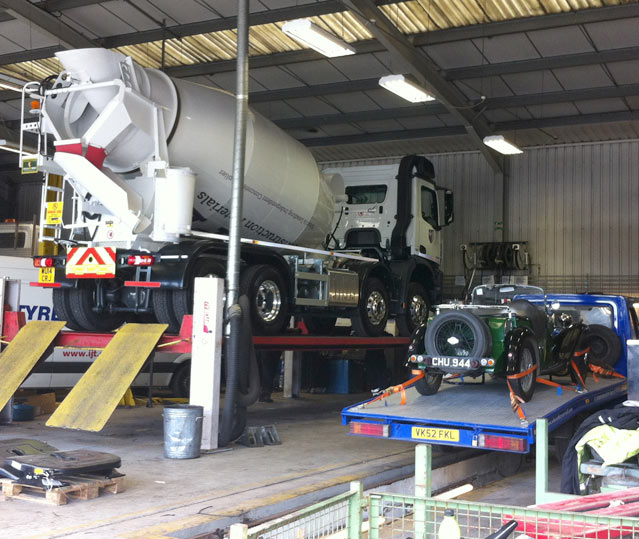
Ground Control and I are going back to Kidderminster tomorrow to pick up the Sprinter (still loaded up with Chattie) after its service. A rather expensive service, as it turns out, but at least we know the Sprinter is good and roadworthy. We had to take it to the Mercedes-Benz dealer, and as I chatted to their Service Advisor, Andrew Brown, he said, ‘My father was in the RAF, too’. Turns out his father, Thomas Royster ‘Roy’ Brown, was a Ground Crew engineer with one of the reconnaissance squadrons. ‘In fact,’ said Andrew, ‘It’s funny you should come today, because I’ve got this with me; it’s from a Spitfire’ and he reached down beside the desk and picked up a piece of equipment that looked like something you might use for technical drawing. See photo:
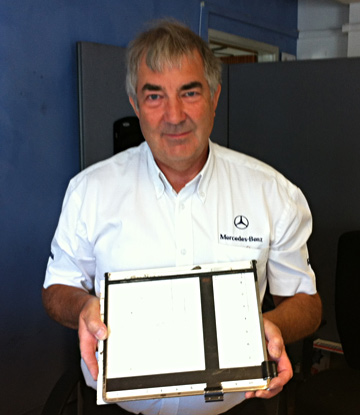
Andrew Brown, with equipment from his father’s Spitfire reconnaissance squadron, used to translate the photographic information into accurate compass bearings and miles to target.
Andrew explained that his father worked on the photographs brought back by the reconnaissance Spitfires, taking the plates off the aircraft and analysing them, in order to work out the distances and degrees on the photographs and translate them into miles and readable navigation routes. These would then be fed back to the bomber squadrons, pinpointing the target and how they were going to reach it: a vital part of the ability of Bomber Command to get its planes to target successfully. This piece of equipment Andrew is holding, calibrated for this purpose, was used in this way by his father.
Meanwhile, Chattie is in good – if rather overwhelming – company!
Filed under Aviation, Aviation history, Second World War, Uncategorized
Night Fighter Navigator by Dennis Gosling DFC
Again, at Shobdon, I was talking to a lady whose relative had been a radio operator during the war, and this brought to mind a great book I have read recently: “Night Fighter Navigator: Beaufighters and Mosquitos in World War II” by Dennis Gosling DFC. I was particularly interested in his account because in many ways it mirrors that of my father, who also flew Beaufighters and Mosquitos as a night-fighter. His long-standing navigator was Flt Sgt Ralph Gibbons, and Dennis Gosling’s book gave me a rare glimpse of the story from the navigator’s point of view. My father’s experience of the RAF was almost universally positive and friendly; Dennis Gosling’s was not like this at the beginning of his wartime career but later he realised he had been unfortunate and his later squadrons were much more welcoming, with the social integration of rank and class more like that of my father’s remembrance. I found it a good page-turner, even though it’s not a traditional ‘action-packed’ account of war, and would recommend it for an interesting and touching read.
Filed under Aviation, Aviation history, Second World War, Uncategorized


 Where They Served