I am a musician by training and temperament (no need to comment here, if you know me!). I have had something of an initiation into classic and vintage cars through my husband, AKA Ground Control, but now of course with acquiring ‘Chattie’ the 1935 Singer and knowing I am going to be spending most of the summer driving her, my initiation is having to be much more practical and hands-on. A revelation in this process is seeing the engineering work being carried out on ‘Chattie’ by Pin Thetford of Thetford engineering, which is something on the level of an art form. There is an elegance in the way in which the structure and design of the car, the materials, the variables, the minuscule measurements and the almost intuitive understanding of how the whole works in harmony with its parts come together, that is a pleasure to witness. I would urge you to have a look at Pin’s latest blog about king pins and bushes, titled ‘Strange Measurements’: http://www.thetfords.com/blog/ You won’t be disappointed, I promise!
Want to find your relative’s service record?
Want to find your relative’s service record?. Since publishing ‘Flying Blind’, so many people have asked me how to go about finding the service record of someone in their family that I have given some information about it on my Flying Blind website: www.flyingblindnightfighter.com
Filed under Uncategorized
Air Gunners
Have a look at this website dedicated to the brave men who sat in the back of an aircraft in a turret or other exposed capsule, watching out for and firing at the enemy: http://www.air-gunners.co.uk
Fighter pilots often owed their lives to their gunners, and vice versa. With the changing technology and needs of warfare, gunners often changed jobs, learning to be wireless operators or radar operators. When 256 Squadron converted from Boulton Paul Defiants, which required a gunner to operate the armed dorsal turret, to Beaufighters, which had radar operators instead, the Squadron’s gunners were given the opportunity to retrain as ROs if they desired. Many of them declined and were transferred to Bomber Command in early 1942. By Christmas that year, my father had learned that all of those who transferred were lost in action, apart from one who was a POW.
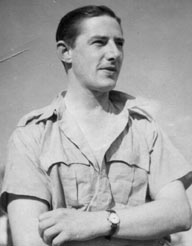
Flt Sgt Ralph Gibbons 1943
On occasion, Dad’s RO, Ralph Gibbons, even had to act as gunner in a Beaufighter when they were converted to daytime coastal command duties, operating a Vickers gas-operated machine gun. Under fire from ME109s, he did his best to defend their Beaufighter while my father put the plane into full throttle and took emergency evasive action. One plane was shot down beside them, another never returned to base. Ralph was trained initially as a ‘navigator’, and his skills and expertise were continually being developed throughout his wartime career. He spent some time on returning from North Africa as an instructor within Bomber Command, and finished his service on Mosquitos, flying not with my father but with a Flt Lt McAlpine on 23 Squadron at Little Snoring in Norfolk. If anyone has any information on Flt Lt McAlpine, I am sure Ralph’s family would be delighted to learn more about him.
Filed under Uncategorized
Courage
Why do we – why do I – celebrate the past so much? There is a resurgence of interest in the first and second world wars. I know that I am drawn to the fact that ordinary people endured and acted with incredible courage in the most testing of circumstances. Some had a naturally daring spirit, and those people are particularly celebrated as heroes – they seemed to have a reckless bravado which propelled them into exultant action and drew others with them. But for me, that exceptional sense of defiant daring is not what I celebrate most. The majority of people did not have that positive desire for risk, that kind of madness. Even so, they did have a sense of adventure, they did experience the thrill of risk and action and wanted to come out of it well, whether they survived it or not (I speak for my father here, as I think that’s how he felt about it). They knew they could die at any time, but pushed that fear down and got on with things, doing the best they could and believing completely that what they were doing had to be done and couldn’t be shirked. The first world war saw thousands of people facing certain death day after day, for months and years, living in the most apalling conditions while in the trenches, bearing the loss of their comrades, the ever-present trauma of that warfare, and the hellish conditions. Staving off despair in the those circumstances – all that was courage, the courage of those days, the courage they were all called to embrace.
But this week particularly I been wondering about courage today and what it means for us to be courageous. Let’s not think that courage belongs to the past, or to those who serve in the armed forces or rescue services today. It belongs to all of us. It has been shown in France this week, and wherever there is an attack on freedom, there will be the courage that rushes in to help victims, combat the threat. It’s shown in the Ebola outbreak where people continue to put their own lives on the line to work in healthcare in those areas. This, too, is easy to celebrate. There is the required courage to speak out and not be silent when something is happening that one knows to be wrong; that is encumbent on all of us.
There is also courage shown in daily life that is not so easy to celebrate because it’s harder to see, and ‘celebration’ seems a difficult word. The shining courage of someone like Kate Gross, who faced dying of cancer in her 30s with such grace and openness and authenticity. The courage of those who get on with their lives after suffering bereavement; of those with long-term illness, or paralysis, and of those who look after them every day; of those facing loneliness in old age: these also are trenches where nobody wants to be; where the endurance seems to have no end in sight, and where, often, there is a sense of loneliness. Living hopefully and positively here is also a kind of warfare: courage on a slow fuse. Let’s not forget that courage of many kinds is around us in many guises; perhaps not to be ‘celebrated’ but recognised, acknowledged, respected: let’s support it in others where we can, and live it in ourselves where we must.
Filed under first world war, Second World War, social history
New ‘FLYING BLIND’ website
A new website for all matters relating to my father’s memoirs,
‘FLYING BLIND: THE STORY OF A SECOND WORLD WAR NIGHT-FIGHTER PILOT’ by Bryan Wild and Elizabeth Halls, with Joe Bamford
is now launched.
READ ALL ABOUT IT! CHECK IT OUT HERE!
URL: www.flyingblindnightfighter.com
Short link: http://wp.me/P5zBn5-1
Filed under Aviation history, books
Singer progress
Chattie has been in the workshop of Crispin Thetford, who has done some good work in stripping the engine down and giving it a thorough overhall. This is a work in progress. For the petrol-heads among you, the engine before stripping looked like this:

Obviously, with some modifications since 1935 but basically still the same old machine. Crispin’s report on the work so far is wonderfully detailed, but in summary:
- New head gasket fitted nicely on the block and tightened down with a good ‘feel’.
- carburettors stripped and cleaned – previous attention to throttle spines and butterflies means these are still in good order. Engine running nicely now.
- Distributor contact sets replaced. Ignition timing didn’t need altering
- Cooling fan (a post-war modified fan blade assembly) mounting studs were very poor – in danger of failing and the bearings were breaking up the fan pulley – fan blades were pressing on the outer bearing. So Pin has machined the centre of the blade assembly and fitted new bearings and mounting studs. Need for further mods will now be assessed.
- Sump taken off – a very wise decision as water seems to have been getting into the oil for a long time – the inside of the sump and oil baffle plate were very rusty and flaking. All cleaned up, treated and coated. One big end cap inspected – good standard originally, some deterioration because of running with water in the oil, but probably good for another 10,000 miles. This is good news as my tour means I’ll do between 2,000 and 5,000, depending how much mileage I do directly in Chattie, and how much in the Sprinter with Chattie on the back.
- New brake master cylinder fitted. However, there are leaks on brake pipes due to previous use of incorrect flaring tool having weakened the copper pipe.
In Pin’s words, ‘The end result is a car which drives again – and it goes very well indeed’. That’s the story so far. There is a ‘But’ – but this post has been long enough, so that appears in the next update! There is also much more to assess and decisions to be made as to what other modifications we wish to make.
Filed under Uncategorized
RAF Coltishall days remembered in the Eastern Daily Press
An article appears today in the EASTERN DAILY PRESS about Flight Lieutenant Bryan Wild’s memoirs of his time in East Anglia with 26 Squadron from October 1944 to June 1946.
To buy a copy of ‘FLYING BLIND’ on AMAZON UK CLICK HERE
To buy a copy of ‘FLYING BLIND’ ON AMAZON WORLDWIDE CLICK HERE
To buy a copy of ‘FLYING BLIND’ from the publishers FONTHILL MEDIA CLICK HERE
Sophie Wyllie interviewed me over the Christmas holidays, and asked particularly what it was like to read my father’s diaries for the first time:
Mrs Halls, 56, from Herefordshire, said reading his diaries was like meeting her father when he was in his 20s.
She said: “Diary entries are very different to how people present themselves. It was quite extraordinary reading my father’s diary. When I was growing up he never talked about the war. When I read the diaries I felt as though I was with him in the cockpit.
“He was young and adored flying aircraft. The RAF was a family for him.”
Before arriving in Norfolk, Flt Lt Wild flew with 46 Squadron from Egypt and Cyprus between 1943 and 1944.
While at Coltishall between October 10 and October 27, 1944, he flew Mosquitos which he described as breathtaking.
“He liked East Anglia, its pubs and friendly local people. He was very happy there,” Mrs Halls added.
Filed under Uncategorized
New Year’s Eve RAF party 1943
Booing out the old year and bringing in the new at 46 Squadron’s New Year’s Eve party, 1943:
‘The night before there had been an ENSA show, and many of the members stayed on for it. Together with the wrens, this made around seventy guests in all, and the biggest Squadron party ever. As before, after helping to decorate the Mess, I drove over to Alexandria with Jack Barnes and collected some of the wrens from the Sacre Coeur in Alexandria. It was a splendid evening. There had been a lot of rain over the previous weeks, so a large marquee was erected, and there was a huge bonfire outside. Once again the RAF Dance Band from Aboukir played for us. As midnight was counted down, Doc MacDonald made a dramatic entrance through the front door of the Mess dressed as an ancient old man, representing 1943, and was booed and heckled as he made his way through the crowded room and out at the back door. He was in fact the oldest member of the Squadron and, as it happened, I was the youngest. I therefore landed the job of representing the New Year, 1944, and, as the Doc exited bang on midnight, a flaming punch was served, and in I came, dressed as a baby with sheets for a nappy, and cheered to the nines. Not my finest hour, and no one from ENSA took my details for future bookings, but great fun all the same. We just about managed to squeeze everyone into a huge circle to sing Auld Lang Syne. It was 1.30 in the morning when Jack Barnes and I took our three wrens back into Alex. As Jack snoozed on the way home, I reflected on a year full of strange and powerful experiences. As I turned the car into the camp at 3.30 a.m., I knew that despite all the difficult things I had seen and been through, I was actually having the time of my life.’
From: ‘Flying Blind: The Story of a Second World War Night-Fighter Pilot’ published by Fonthill Media
Filed under Uncategorized

Christmas Officer’s Mess party 1943
Extract from Chapter 8: ‘Christmas and New Year in North Africa’: Some of you may recognise Charlie Peace, featured in the previous photograph, seated cross-legged on the floor at the front of the throng.
‘The next week was the Officer’s Mess Party on 10th December. This was a big affair for the Squadron, with around fifty guests invited to a dance and a buffet supper. Owen’s Cairo West detachment was now closed and all the aircraft returned to base, so the Squadron had its full complement. We spent all morning decorating the mess with whatever we could find; mostly palm leaves, which looked marvellous, I thought. 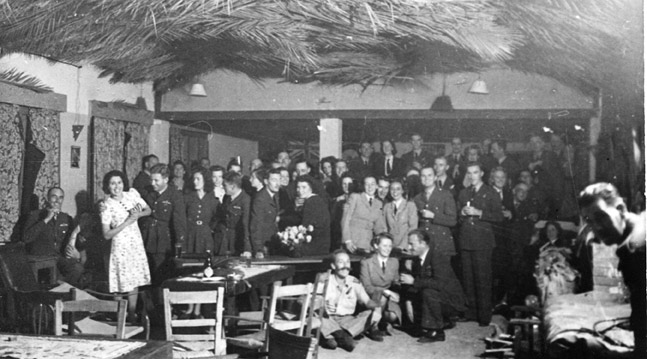 In the afternoon I put on best blue and went into Alex int he CO’s car, with Dudley Arundel, Jenx, Jack Barnes and Atkins. We had a few drinks at the Cecil to get in the swing of things and then picked up the invited Wrens from the ‘wrennery’ and took them to Idku with us in style in the three-tonner. The party was one to remember. There were plenty of girls and eats to keep us all happy. The RAF band had been brought in from Aboukir and we danced the evening away in the open under a brilliant moon. It was a magical setting.’
Filed under Uncategorized


 Where They Served